
resources
Most Affordable Personal Trainer Certifications with Accreditation
23 Oct 2026

Getting certified as a personal trainer should not cost more than your first month of client income. Affordable certifications are surprisingly hard to evaluate, though, mostly because the market is cluttered with options that look legitimate and lack real accreditation. Add confusing accreditation language to that, plus genuine uncertainty about which credentials gyms accept, and a decision that should take an afternoon stretches into weeks. This guide covers the providers worth your time.
Behind the ranking
Each option was evaluated by pulling publicly available information from official websites, user review platforms, and case study sources. Ratings, program features, and student feedback were all factored in, and only providers with a clear track record in fitness education made the cut. The full method is set out below.
Where a body offers member pricing, the non-member price is quoted throughout, because membership costs money in its own right and a first-time candidate rarely has it.
- IPTA (International Personal Trainer Academy): best for aspiring trainers who want NCCA-accredited certification with career support and affordable pricing.
- NASM: best for candidates who want the certification top gyms recognize by name.
- ACE: best for a nonprofit-backed credential with a long track record.
- NSCA: best for strength and conditioning work.
- ACSM: best for exercise science and healthcare-adjacent roles.
What each one actually costs
Prices move and most providers run standing discounts. Confirm current figures before enrolling.
| Certification | Exam only | Realistic full cost | Retake | Renewal |
| IPTA | $399, textbook included free | $399, or $799 MVP | Free and unlimited at MVP | 24 CEUs / 2 yrs, first free at MVP |
| NASM | $599, no materials | $749 on sale | $200 | 20 CEUs / 2 yrs, $99 |
| ACE | $499, no materials | $587 discounted package | $199 | 20 CEUs / 2 yrs, $129 |
| NSCA | $435 non-member, no materials | Approx. $870 with materials | $435 | 60 CEUs / 3 yrs, $70 |
| ACSM | $410 non-member, no materials | $609 with prep course | Paid retest | 45 CEUs / 3 yrs, $60 |
The real impact of an affordable certification
Picking the wrong one costs more than money. All-in costs, including study materials, exam fees, and CPR certification, add up quickly, and the total looks very different depending on which program you choose.
The harder problem is knowing which certifications open doors. Not every program carries NCCA accreditation, which is the standard most major gym chains apply when evaluating new hires. Paying for a credential without it can mean starting over.
A well-chosen certification affects your first-attempt pass rate, how quickly you get to work, and what you have spent by the time you take on a first client. That combination matters more than any single feature a program advertises.
What "affordable" actually means on a certification
Three costs sit outside the enrollment price, and each one catches candidates who compared only the headline figures.
The textbook. Most providers treat it as a $100 to $200 add-on. NSCA effectively doubles its own cost this way, selling the exam on its own and charging roughly another $435 for the study program. ACE, NASM, and ACSM all leave it out of their exam-only prices too. IPTA gives the textbook away free to anyone starting a trial, with no card required, so a candidate can read the whole curriculum before spending anything.
The retake. Nobody plans to fail and nobody budgets for it. Across this list a second attempt runs from $199 at ACE to $435 at NSCA, which is more than IPTA's entire exam price.
The renewal. Every credential expires. Over four years that is $258 at ACE and $198 at NASM. NSCA and ACSM both run three-year cycles at $70 and $60, cheaper per renewal but with heavier CEU requirements. IPTA's first recertification is free at the MVP tier.
There is one more trap worth naming, because it undoes the comparison entirely. ACE's package price does not include the NCCA-accredited version of its exam, which is the version most gyms accept. That upgrade costs $99 on top of the listed price.
Candidates asking which certification is genuinely the most affordable reach the same conclusion once they add those three numbers, and a long-running r/Kinesiology thread on the most affordable personal trainer certification lands in the same place once the replies move past sticker prices. The enrollment price decides very little on its own.
IPTA (International Personal Trainer Academy): best for accredited, affordable entry
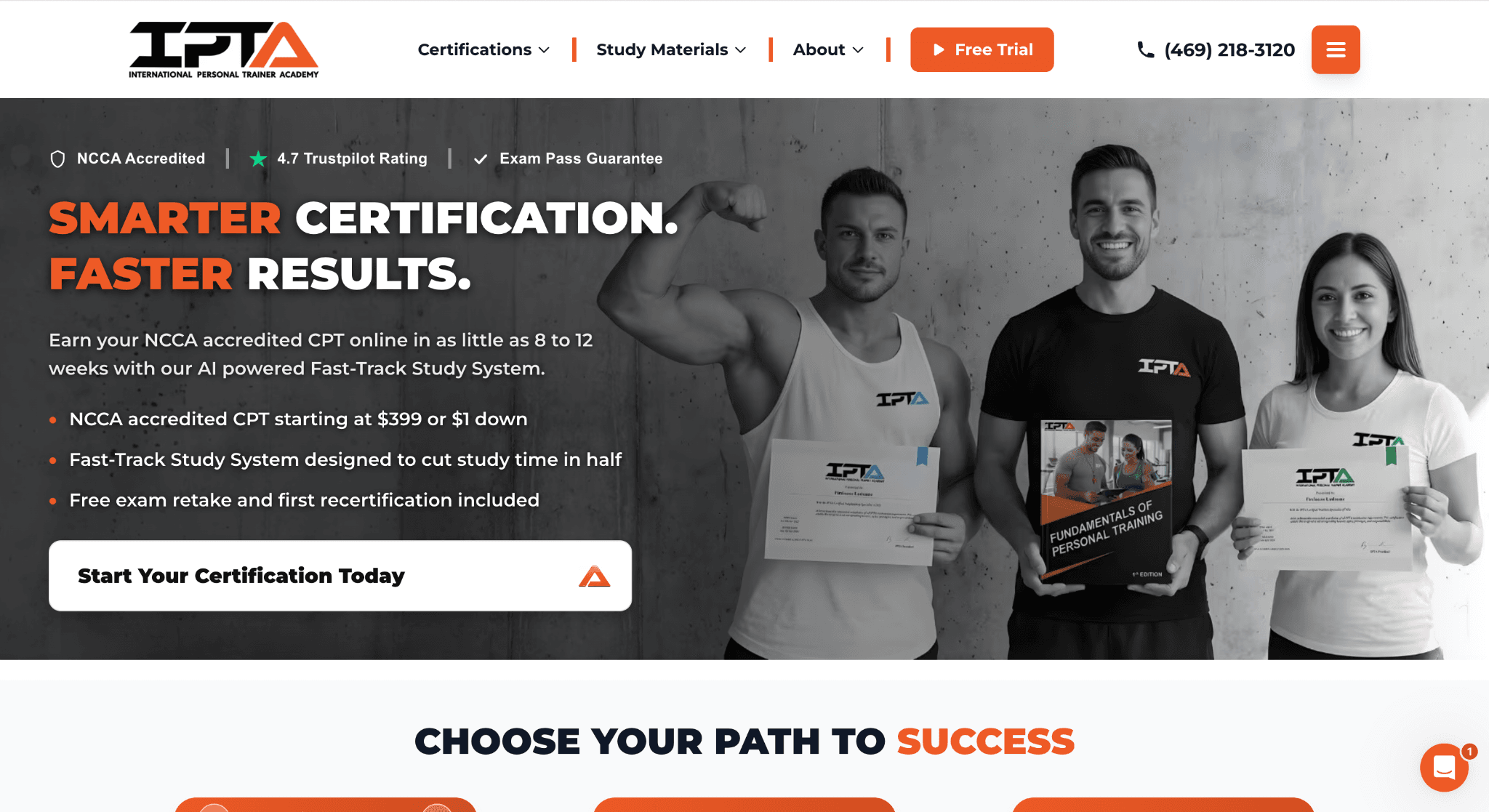
How does IPTA operate?
IPTA delivers a fully online, NCCA-accredited personal trainer certification alongside specialty programs in nutrition, bodybuilding, corrective exercise, strength and conditioning, and group exercise. It also covers exam prep for NASM, ACE, ACSM, ISSA, and NSCA, so a candidate is not locked into one pathway.
The study system is what separates it. Research-backed sequencing and AI-driven adaptive review cut study time by up to 50 percent, which puts a focused candidate at a credential in weeks rather than the three to nine months a CPT usually takes. The digital textbook now runs an AI layer over the material as well, so you can question it directly and pull targeted revision on weak sections instead of rereading a chapter from the top.
Why is IPTA a contender for affordable certification?
$399 covers the accredited exam, and the textbook is free on trial signup with no card required. That makes it the only entry price here that does not send you shopping for study material afterwards. Twelve interest-free payments are available with no credit check. A video walkthrough of the certification covers what the rest of the process involves if you would rather watch than read.
The $799 MVP tier now runs as buy one, get one free. Every MVP candidate takes a second certification at no extra cost, choosing from the five specialties above, which works out to roughly $400 per credential. MVP also carries unlimited free retakes, CPR/AED certification, a free first recertification, SurePass AI, a job assurance guarantee, and lifetime access to IPTA's personal training software, which is a subscription cost removed from the business before it starts.
What to weigh
IPTA is the newest name here and carries less recognition than NASM, so check what your target gyms list before enrolling. There are no live classes, and a print textbook is available at extra cost rather than bundled. The $399 tier is an exam tier: the retakes, the CPR/AED certification, the second certification, and the software access all sit at MVP. Guarantee eligibility terms are worth reading closely, as they are anywhere.
Real user sentiment
Students consistently point to the study system and the exam pass guarantee. IPTA holds a 4.7-star Trustpilot rating, with coverage from Forbes, Entrepreneur, and USA Today adding to its credibility.
NASM: best for industry-standard recognition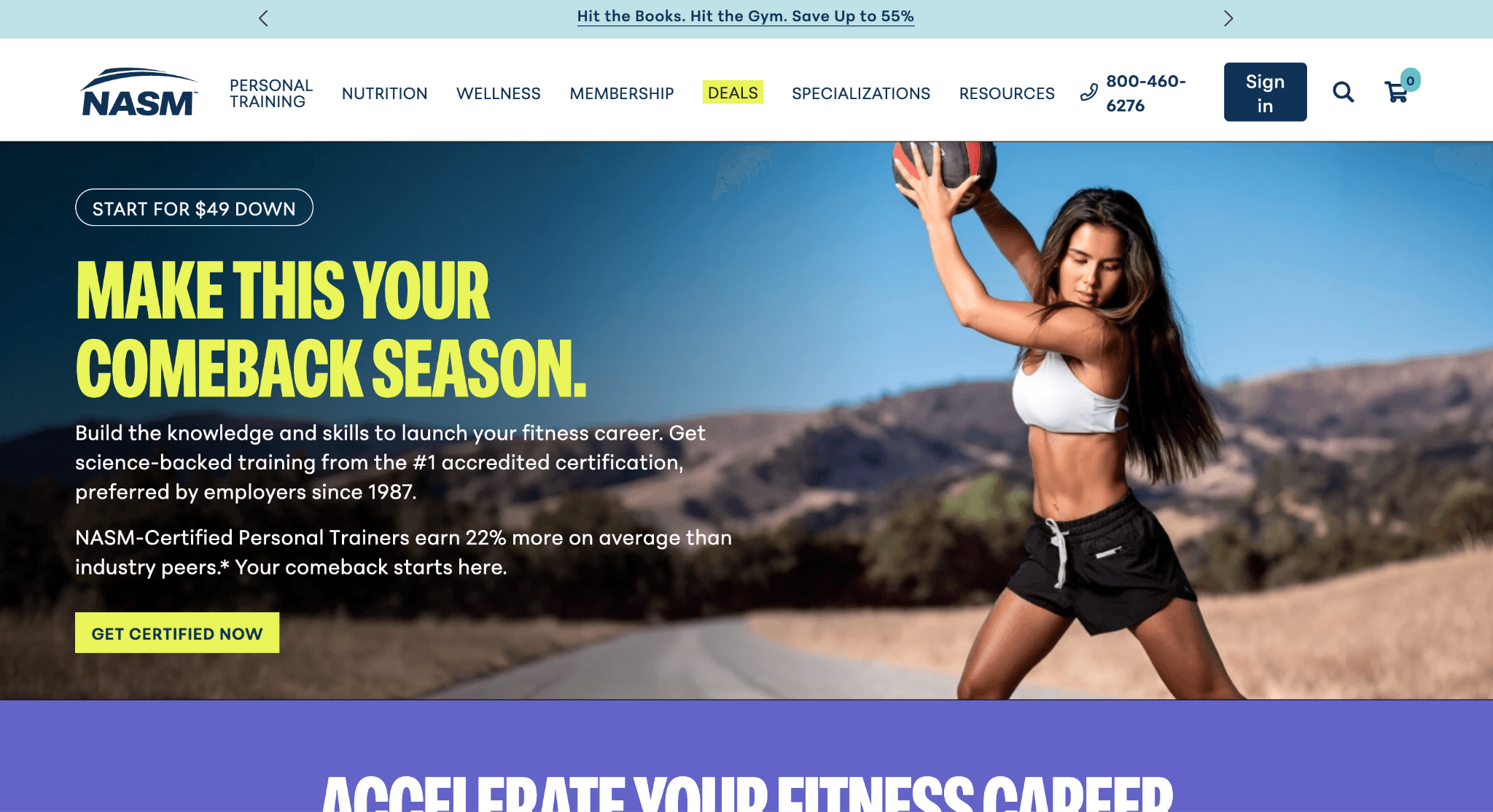
How does NASM operate?
NASM has certified fitness professionals since 1987, and with more than 1.4 million individuals certified across over 100 countries it is the closest thing to an industry default. The Optimum Performance Training model runs through the Certified Personal Trainer program and the specialty certifications in corrective exercise, nutrition coaching, and sports performance. NASM-credentialed professionals work throughout major professional sports organizations, and more than 14,000 gyms accept the certification.
Why is NASM a contender for affordable certification?
For candidates who want employer acceptance without having to explain their credential, NASM removes the uncertainty. The breadth of its gym partnerships and the depth of its curriculum make the credential one of the most transferable available.
What to weigh
It is the most expensive route on this list. Even discounted at around $749, the self-study package costs nearly double IPTA's exam price for the same accreditation, and the exam alone is $599 with no materials. A retake is $200, and the material is dense enough that a beginner should plan for several months.
Real user sentiment
NASM's reputation rests more on industry data than individual reviews. Repeated inclusion on Newsweek and Statista's ranking of America's top online learning providers from 2023 through 2026 shows sustained relevance, and hiring managers treat the certification as a reliable signal of candidate quality.
ACE: best for a nonprofit-backed credential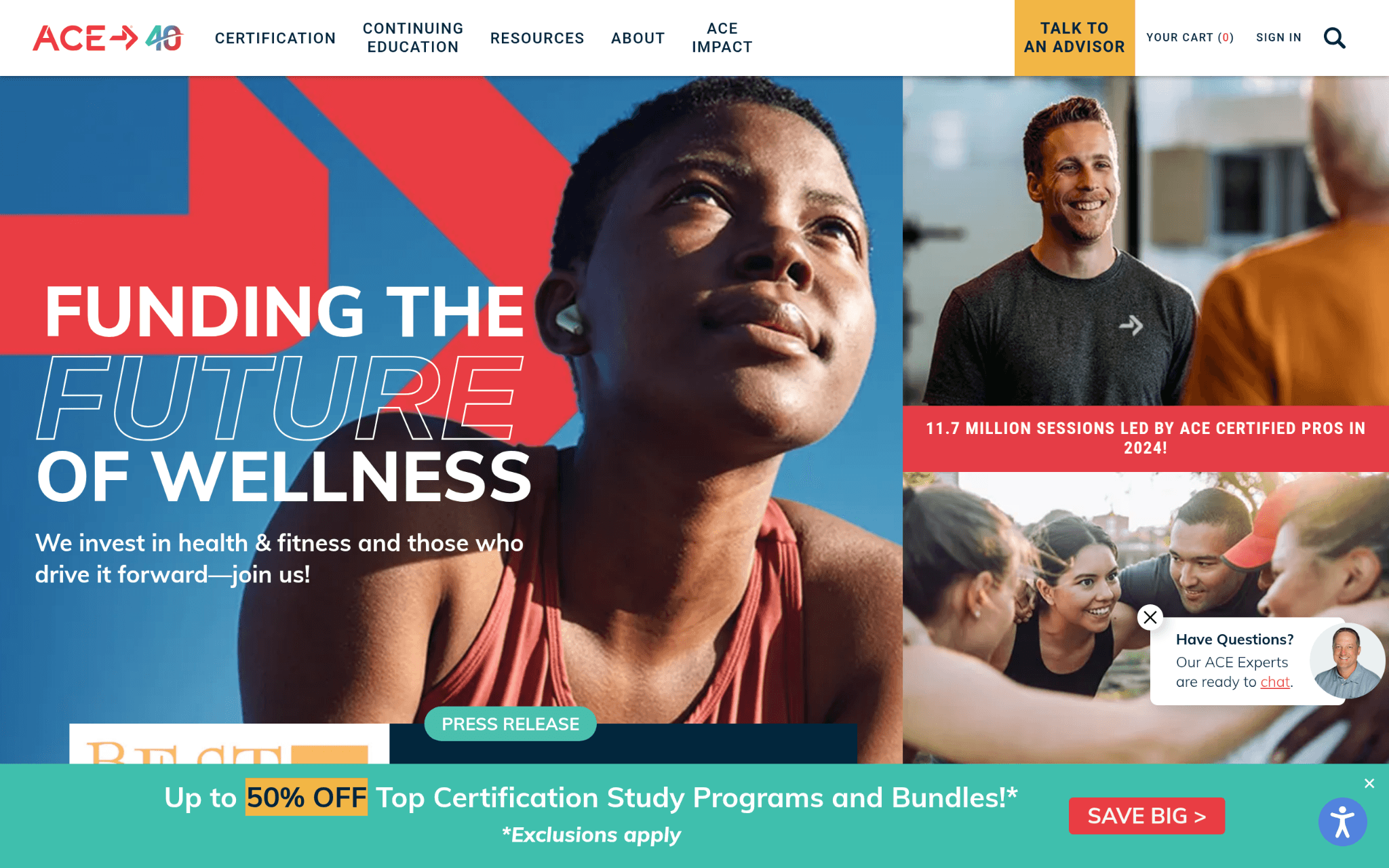
How does ACE operate?
ACE has operated as a nonprofit since 1985 and holds NCCA accreditation across four certifications: Personal Trainer, Group Fitness Instructor, Health Coach, and Medical Exercise Specialist. With 90,000 certified professionals across six continents, it is one of the most geographically spread fitness education bodies anywhere. Specialty programs in senior fitness, weight management, and sports nutrition give certified trainers room to grow beyond the base credential.
Why is ACE a contender for affordable certification?
ACE addresses the trust gap that comes with choosing a certification, pairing a nonprofit structure with accreditation that carries weight among employers who scrutinise credentials. A 40-year track record means the market already knows what the credential represents, so graduates spend less time explaining it.
What to weigh
The ongoing costs are the issue. A $199 retake and $129 every two years compound faster than the entry price suggests, and the $99 charge for the accredited version of the exam is the one that catches people. The $499 exam-only option makes little sense next to the $587 package, which is $88 more and includes everything.
Real user sentiment
ACE's standing shows up in recognition rather than student testimonials. Being named a 2026 Best and Brightest Company to Work For and a Nation's Best and Brightest in Wellness winner suggests an organization that practices what it teaches.
NSCA: best for strength and conditioning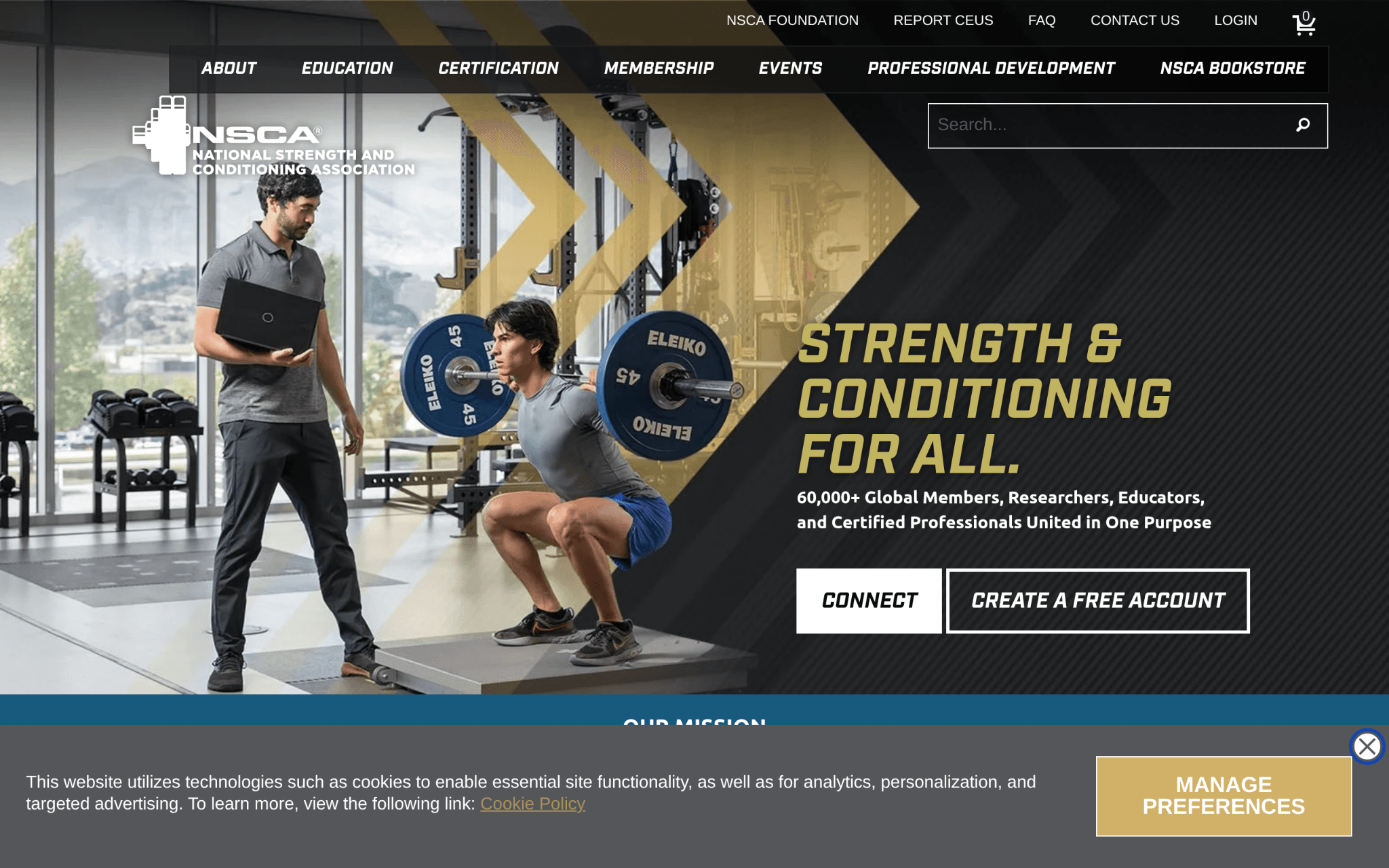
How does NSCA operate?
NSCA has operated as a nonprofit since 1978 and serves more than 60,000 members globally. It offers five certifications, including the CSCS and the NSCA-CPT. It also publishes two peer-reviewed journals and produces the NSCA Coaching Podcast, which makes it one of the most research-active organizations in the field.
Why is NSCA a contender for affordable certification?
NSCA bridges academic research and practical coaching, which matters for trainers working with athletes or performance-focused clients. The credential carries weight in settings where the science behind a training approach is expected to hold up.
What to weigh
The pricing model works against a budget candidate. The $435 exam buys the test and nothing else, study materials add roughly $435 again, and no payment plans are offered, so the full amount is due up front. The $435 retake is the highest here by a wide margin, and the exam is offered in person only.
Real user sentiment
NSCA does not generate the consumer review volume that more marketing-forward organizations do. Its 45-year presence and global membership speak for it instead, and professionals who pursue NSCA credentials tend to be serious about the research side of the work.
ACSM: best for exercise science and clinical settings
How does ACSM operate?
ACSM was founded in 1954 by physical educators and physicians, making it the oldest and largest sports medicine and exercise science organization in the world. It serves nearly 50,000 members across six continents through certifications, six peer-reviewed journals, more than 300 online education courses, and annual conferences. Its Exercise is Medicine initiative gives certified professionals a framework that crosses into clinical settings.
Why is ACSM a contender for affordable certification?
ACSM suits trainers who want to work where fitness meets healthcare, and where a scientifically grounded credential matters to clients and referring practitioners alike. Its depth of published research makes the certification particularly credible in medical fitness and rehabilitation-adjacent environments.
What to weigh
The exam-first model makes the entry price look lower than the real one. The exam alone is $410 for non-members, the bundle with a prep course and practice exam is $609, and study materials beyond that are extra. There is no published standard timeline either, which makes planning to a deadline harder than it should be.
Real user sentiment
ACSM's credibility comes from the scientific community rather than review volume. Nearly 70 years of operation and a global network of 50,000 members have built a standing in both the fitness and medical communities that would be difficult to replicate.
How these were chosen and verified
Gathering information. The initial research pulled from official program websites, fitness education directories, student review platforms, and case studies from industry publications. Certifications, accreditation status, pricing structure, and career support features were documented from publicly available pages. The goal was coverage rather than early filtering.
The shortlisting pass. Options without verifiable accreditation or a documented track record were removed. Review patterns were analysed for consistency rather than volume, and providers with a handful of glowing reviews but no depth of feedback over time were flagged. The shortlist kept only options where student outcomes, exam support quality, and employer acceptance could be reasonably assessed from the public record.
Verification. Published claims were cross-checked against independent review sources and available student outcome data. Accreditation status was confirmed against recognized standards. Specific claims about pass guarantees, career support, or gym acceptance were checked against external references and user accounts. Gaps between what a program advertised and what students reported fed into the assessment.
Industry recognition. Publication mentions, ranking inclusions, and industry awards were all evaluated. Organizations with peer-reviewed research and decades of documented activity ranked higher on authority than newer entrants.
Proof points. Each provider was checked for dedicated program pages, student exam prep resources, and verifiable reviews focused on certification outcomes. Documented all-in pricing, clear accreditation credentials, and specific employer acceptance claims received higher consideration.
What to look for when comparing
Price alone should not decide this. Five things matter more.
Documented experience. Look for years of activity in fitness education rather than a polished website. Long-running organizations tend to have stronger employer relationships and a more refined curriculum.
What is actually included. Exam prep tools, CPR/AED certification, career support, and specialty add-ons all change the real value of what you are buying, and whether they are bundled or sold separately can move the total by several hundred dollars.
All-in cost. Compare exam-only prices first, then check what each leaves out. $399 at IPTA, $410 at ACSM, $435 at NSCA, $499 at ACE, and $599 at NASM look like a narrow spread until you notice that four of the five still need a textbook bought separately. Then add one retake and the first renewal.
Published results. First-attempt pass rates and employer acceptance among major chains are the numbers that matter. If a provider does not publish them, ask why.
Accreditation. NCCA status is the baseline most employers apply. Certifications without it may not be accepted at the gyms where you want to work, and no discount compensates for that.
Final take
Affordability on a certification comes down to accreditation, all-in cost, and whether employers accept it. IPTA offers an accredited credential with career support at the lowest entry price here, and it is the only one where that price includes something to study from. NASM, ACE, NSCA, and ACSM each bring decades of credibility and a specific strength, and any of them is a defensible choice if it matches where you want to work.
Before you pay for any of them, call two facilities in your area and ask which certifications they hire from. Acceptance varies by chain and by region more than candidates expect, and it is the one thing no comparison table can tell you.
References
- PT Pioneer. https://www.ptpioneer.com/personal-training/certifications/cheapest-personal-trainer-certifications/
- Trainer Academy (IPTA). https://traineracademy.org/certifications/cheapest-personal-training-certifications/
- Exercise.com. https://www.exercise.com/grow/cheapest-personal-trainer-certifications/
- Insure Fitness. https://insurefitness.com/affordable-personal-trainer-certifications/


